
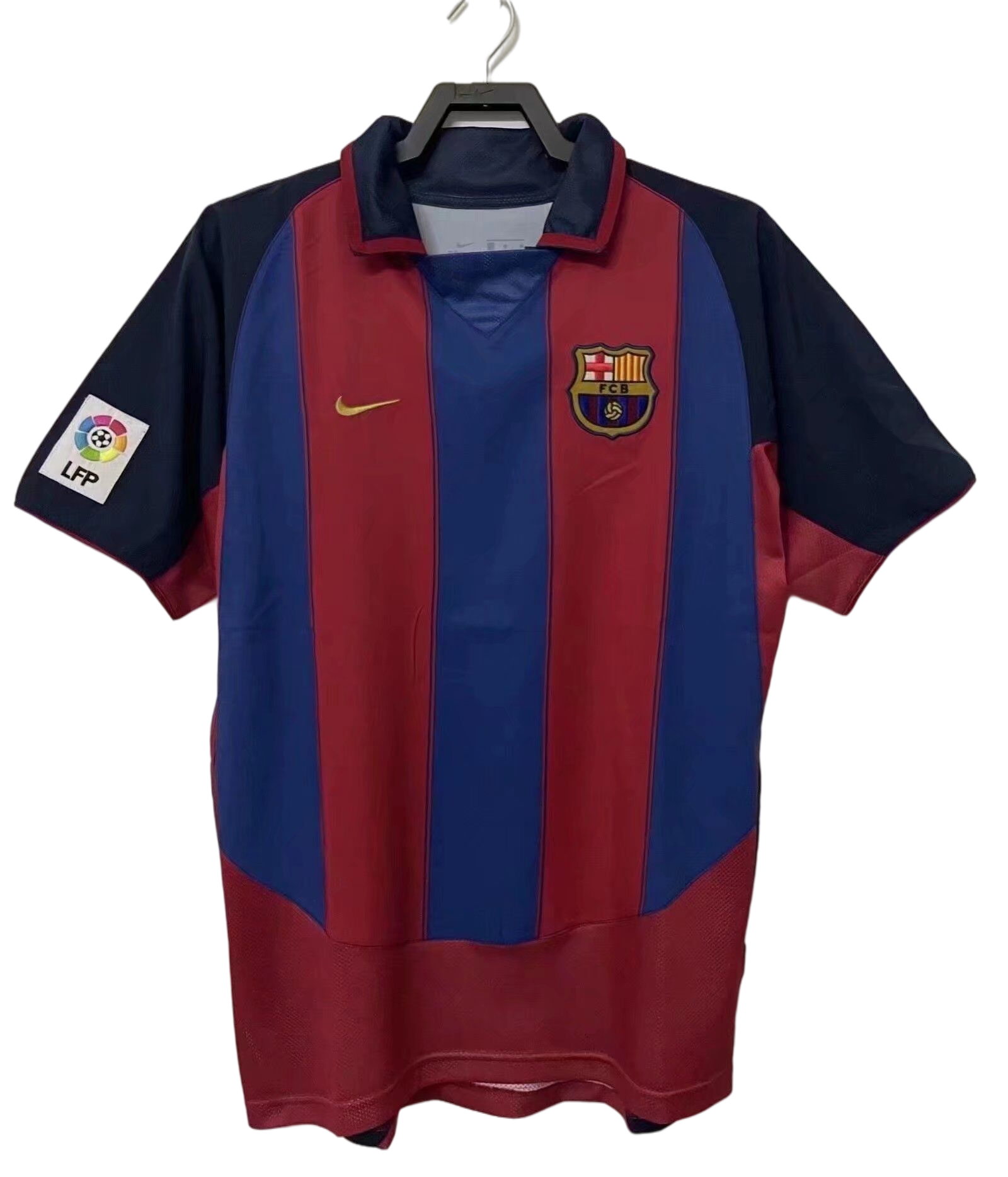
A collar is a small part of a shirt, but it can change the way the whole design is read. It frames the space beneath the face, interrupts the body colour and gives the shoulders a point of reference. Before listing badges or lettering, spend a moment at the neckline.
Look at the opening before the decoration
In our Barcelona 2003/04 reference, the dark folded collar sits above a red-and-blue body. The opening creates a small change of direction where the larger vertical colour blocks meet. Following that shape with your eye is a different exercise from simply naming the colours.
The Real Betis 1995/97 reference offers another reading. Its pale collar stands apart from the green-and-white stripes. The collar is not only an outline: it is a short, quieter interval above the repeated body pattern.
Compare the same area at two distances
At a distance, ask whether the neckline belongs to the main colour field or appears as a separate frame. Up close, follow the edges and the point where collar and body meet. Keep these two observations separate. A detail that looks prominent in a close crop may barely register in a full-shirt image.
Photographs also introduce their own shapes. A hanger can pull an opening wider; a fold can hide one side. Describe the particular image rather than treating its silhouette as a measurement of every example of that design.
Make a pair, rather than a ranking
Place the two references beside one another and give each a short caption: what the collar does to the stripes, where the eye settles, and which contrast survives when the image becomes small. There is no need to decide which is better. The useful part is discovering how two similar pieces of clothing organise attention differently.
Continue with the Barcelona reference and the Real Betis reference. These are observations of archived photographs, not a statement about manufacture, original use or the feel of the garments in hand.